
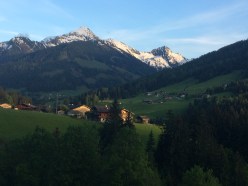
Alpine views
I am just getting back from a three week trip to Germany for work. I was there for two almost-back-to-back conferences near Munich and some visits to labs in between. I must admit that when I planned this trip back in February it seemed like such an efficient plan to hit two conferences in one trip—months later, while packing and organizing for three weeks away, the phrase “what was I thinking” crept to mind. In any case, it turned out to be a good trip, both work-wise and personally. The meetings were both great—interesting science in beautiful locations. The first meeting was in a small village in the mountains in Tirol, Austria. The village had a “Sound of Music” vibe—rolling hills of lush green, cows grazing, mountains in the background, locals dressed in Dirndls and Lederhosen. I kept expecting the Family Von Trapp to come bursting out of the background singing “The hill are alive, with the sound of music…” The second meeting location was equally lovely—-in Seeon in a renovated old historical Benedictine monastery on a lake in the Bavarian mountains. As an outing during the meeting, we went on a hike to another lake, winding up at a hill-side farm where we drank fresh milk from the local cows. It doesn’t get much more Alpine-cute.
I was actually born in just outside of Munich, in Wolfratshausen a small suburb, and lived there for the first five years of my life. I don’t really remember much of anything from those years, but still the trip felt very nostalgic. My Mom and Dad met in Munich, married there and had their three children there. The trip made me think of them too, as young parents. On my last day, I had some time and so took the local S-bahn to Wolfratshausen to check it out. It was fun to see some of the location backgrounds that I’ve seen in my baby photos. This is a picture of my Mom with me as a baby, and in the background is the church spire in this photo.


On one of my free weekends I took the train to Dresden, which is the town where my Dad grew up. I had last been to Dresden in 1989, when I was a student and it was still a part of the former East Germany. It’s a beautiful city, which was totally destroyed during WWII and then largely languished during the East German regime. Many parts have now been restored again. When you’re in Germany you really can’t help but think about it’s history, especially of the awful history of WWII. My parents grew up in the war and its aftermath, when so much of the country was destroyed and then later was divided. Both lost their homes during the war and their families, and like so many, they fled as refugees to new lives in other parts of the country. My parents rarely spoke of those times and what they experienced and it’s only really as an adult, now, even after they are gone, that I’m starting to grapple with just what that must have been like. I image what it must have been like to come of age in times of such instability, in the midst of war and chaos and such devastating loss and destruction. Of course, with the refugee crisis so evident in Europe (you could really feel it in Munich especially), you realize that war and displacement are still a personal reality for millions of people around the world. Today, it’s Syria, Iraq, Afghanistan, and Africa and in places like el Salvador and Venezuela failing economies and internal forces like violence, gangs and unstable politics have as devastating consequences as bullets and bombs.
I feel truly blessed to have grown up and be living at a time and in a part of the world where we have been relatively untouched by war. When my parents left Germany for the US, it was because of a job transfer for my Dad, not because they were refugees. But still, I think often of how they made that decision to uproot themselves and their children (we were three, all below the age of five) from all they knew—their family and friends, their home—for the ambition of a new life, a better life for their family. I think of other parents making that decision today. For some, those decisions are made under good circumstances, looking for adventure or opportunities somewhere else in the world—how lucky to be able to have that choice. But, sadly, for so many confronted with terrible circumstances in their homeland, it’s not a first choice but maybe the only choice they can see for giving their children and themselves a chance at a better life. For all these parents, I am awed by their bravery and selflessness in putting the future of their children first.


 I went to my monthly adoption support group tonight. I try to go most months when I am in town. I am generally glad I do, though it’s a mix of emotions each time. It’s helpful to meet other families in the same boat, but at the same time, it marks the passage of time, another month without a match, feeling that I am stuck and that this is not moving forward, wondering whether this will work out. The mantra is always “patience”,”hang in there”, “waiting is the hardest part.” All that may be true but still, it doesn’t make the waiting limbo feel any easier and in all honesty, hearing the mantra time and time again, just starts to wear thin. There’s always a topic for the meeting, usually some informational component on one of the many, many logistical, legal or sometimes emotional ins-and-outs of adoption. Today’s topic was all about birth fathers and the rights they have in the adoption match. Let’s just say there was a LOT to process, and a lot to start to worry about. In all the training and counseling that goes on for potential adoptive parents, there’s generally a lot of discussion around birthmothers (as there should be) but comparatively less so about birth fathers. But, they are, of course, a part of this too and the legal issues around consent are complicated and the potential complicating scenarios are many. In earlier stages of this, I used to approach these types of discussions by taking tons of notes, sucking in every last nitty gritty detail, learning as much as I can to prepare myself for the possible scenarios. I’m nothing if not a good student and researcher and that’s generally been my strategy for life—arm myself with as much information and preparation in advance, so I can’t be taken by surprise. “Be Prepared,” as the Boy Scout motto goes; an adaptive strategy that probably most Type-A achievers like me learned early in life. But, as time has passed and also hearing more and more adoption stories from adoptive and wanna-be-adoptive parents, it just became clear to me that every situation and story is so different that you can’t really prepare for all the inevitable surprises. And in fact, you can drive yourself (and probably others around you) crazy with trying to foreshadow the possibilities and prepare for every scenario. The best you can do is let go and be open (there’s that word again!) to whatever happens.
 Waiting for my stork